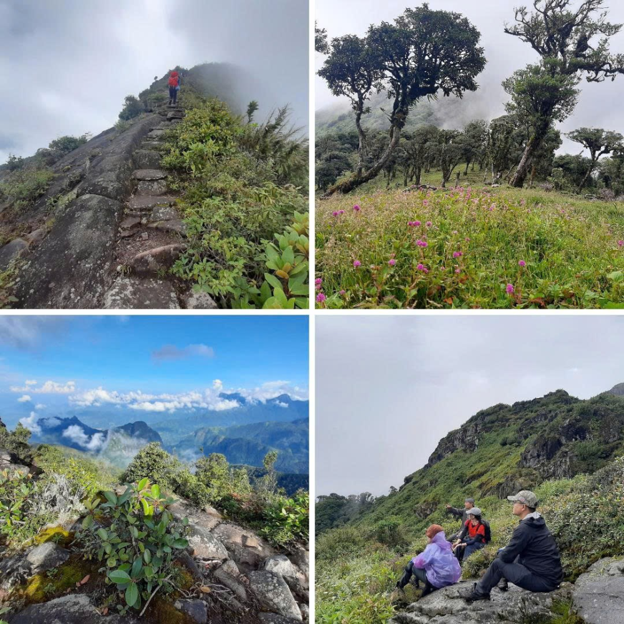
The Call of the Wild and White Fang of Jack London remind me of my feelings and unforgettable moments in the mountain of Ky Quan San – my experiences three years ago. These adventure novels mentioned collective memories. I try to understand the development of the “thoughts” of the hybrid dogs Buck and White Fang: they recalled the sound, activities, and the landscape where their ancient ancestors resided millions of years ago! It is as if these dogs directly experienced those activities and developed such survival skills. And in many circumstances, they could revert to a primitive state to survive. This is to say, the wolf characteristics dominated in their fighting against other sled dogs, wolves, and people. Could it be so in reality? Collective memories? Actually, before compiling these novels, Jack London had one year of experience in the subarctic climate in the Klondike mountainous landscape during the Gold Rush and was relatively familiar to sled dogs. He also read the On the Origin of the Species of Charles Darwin. These were probably the major inspirations and “scientific” foundation of these two novels.
Jack London once mentioned, “It was in the Klondike that I found myself”. I myself experienced a kind of slightly “wild” feelings: adventurous and primitive, while trekking and climbing on the mountain Ky Quan San in the Northwest of Vietnam. A strong connection to nature but did not fully understand why and a feeling like I was myself the most when I were there, explored my self-limitation, and enjoyed the indescribable beauty of nature. And not less important, I sensed the closeness with some members in the trekking group, especially when we were in the middle of nature. We became much more open, because we could be ourselves the most here – our collective primal instincts?
Would this social joy be much less if I climbed this mountain alone? Or are these only moments of escaping some unpleasant aspects of busy and rushed lives in a big, vibrant, and urbanizing city like Hanoi? Or definitely, we are integrated parts of nature and we always long for it? Then another question: whenever we need such a balance or experience spectacular adventure, do we have to travel that far?
I suppose, for many of us, lives can be more fulfilling and relaxed if we can maintain rational social and nature connections. What if Hanoi develops community or city forests within reach for all citizens, particularly in urban areas? Last year, I did some research and found out that the green coverage of Hanoi is only 11.7% with very low forest coverage of 5.6% (nationwide is 42%) and urban trees of 2 to 3 m2/person. This is much lower compared to recommendations (i.e., green space of 30%, urban tree of 7 to 15 m2 per person). Apparently, the city’s master plan aims to increase its green coverage. However, presently community forests in the city are probably a luxury here. Could it be right now, nevertheless, partly compensated? For example, by less-space-demanding solutions, like biophilic designs or nature-based solutions, or simply changing behaviors at a more simple and atomic scale, so that each can participate.
Back to the Ky Quan San, I still treasure my experience here as one of the priceless moments in my life. I believe that many of us deeply and intuitively want to conserve this nature. It is not only because of inspiration sources for possibly famous future adventure novels 😊 like The Call of the Wind and White Fang. It would also be great if future generations can still experience this landscape to its fullest and most original, not via history or novels!
A friend, originally developed from the trip to Ky Quan San, has just texted me “will you join me on the next trekking and which mountain in the Northwest?”. Oh yes, it is now the right season! I say, however, “it depends on the weather forecast”.
P.S.: Thank you An Phương for valuable comments.
Nguyet Tran
The article was first posted on Linkedin on 24 December 2025.
