As someone who has directly accompanied children aged 3 to 6 on their journey to mastering the alphabet, I’ve realized that this period is the most favorable time for children to learn language naturally.
Before the age of 3, children primarily develop language through sounds, listening, and speaking; after 3, there’s a strong shift in the connection between sounds, symbols, and visual cues related to alphabet letters.
The period from 3 to 6 years old is the golden age for language development. According to Dr. Maria Montessori, this is the stage where children possess “absorbent intelligence” – a special ability that allows them to naturally and easily absorb language from their surroundings without conscious effort.
Montessori divided absorbent intelligence into two distinct stages:
* Stage 0 to 3 years old – unconscious absorption:
During this stage, children absorb everything very naturally, without selection. Children learn language unconsciously through daily activities; for example, a 2-year-old can speak their mother tongue simply by listening to adults communicate daily.
* Stage 3 to 6 years old – conscious absorption:
At this stage, children become more aware of the learning process, learn to select information, and begin to set goals. This is when the absorbent intelligence shifts from “passive absorption” to “active construction.”
According to research from the Harvard Center for Child Brain Development, approximately 80% to 90% of neural connections are formed before the age of 6. However, that doesn’t mean children need to be forced to learn; instead, they need to learn in the right way. The brain has an extremely high density of neural connections, and children learn language through observation, memorization, and learning from their surroundings. Children absorb information most effectively when they directly manipulate objects, practice, and explore. During this stage, children observe the behavior of adults and friends, then imitate what interests them and what they find meaningful, a process called selective imitation. Simultaneously, their vocabulary, expressive abilities, and communication skills skyrocket, and they develop storytelling skills through frequent listening, speaking, and interaction.
Characteristic signs easily noticeable when children reach the peak of this language development stage include:
- They are curious about signs and billboards, searching for familiar letters;
- They pretend to hold books and stories like adults;
- They enjoy word-matching games;
- They actively ask adults about spelling;
- etc.
At this time, the child’s brain has a photographic mechanism and the ability to quickly memorize images thanks to the developing right brain, which excels in visual thinking. Therefore, parents should take advantage of the time and opportunity to support their children during this sensitive period, specifically between 3 and a half to 4 years old.
Between the ages of 3 and 6, children’s right brains are developing rapidly and becoming dominant, while simultaneously, the left brain begins to form initial logical connections. The right brain receives images, while the left brain processes information, leading to good associative thinking. When children are introduced to letters correctly, both hemispheres of the brain are stimulated to develop.
Neural pathways that are regularly supported, such as language and images we see and hear daily, will have their myelin sheath strengthened, allowing for faster information transmission. During this stage, the more exposure and support children receive in language, conversation, and learning through flashcards, the faster they will learn. Conversely, unused connections will be discarded. Therefore, we should prepare a rich learning environment with engaging materials. After teaching academics, we should include reinforcing activities such as cutting and pasting, sculpting letters, coloring letters, finding letters as requested, etc. Creating opportunities for children to experience things firsthand instead of just listening to lectures is crucial. When multiple senses are activated – seeing, hearing, touching, reading, and thinking—memorization becomes much more natural and lasting. That’s why visual learning materials are always so effective.
The age range of 3 to 6 years old is not a time for creating academic pressure, but rather an opportune time to sow the first seeds of language, thinking, and a love of exploration. Neglecting this stage can inadvertently lead to missed opportunities for strong language development in children. Therefore, preparing a safe and enriching learning environment is vital for their long-term learning and character formation. Above all, the responsibility of adults is not just observation, but also to accompany and create a positive, rich, humane, and language-rich living and learning environment where children can fully develop.
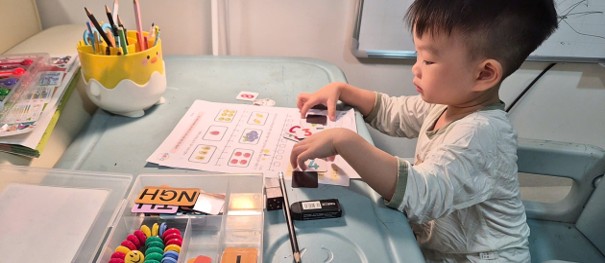
Photo caption: Picture of Leo studying at home with his parents (Photo: Leo’s mother, June 2026, with permission)
– This English version is translated from the Vietnamese version using Google Translate with revisions.
Ha Giang