
I was sitting next to the window of a bus in the early morning at the end of September. When the bus was about to leave, a young woman got in. I looked at her and smiled. I thought I met her somewhere but did not remember. While thinking, I suddenly heard a voice: “Can I sit here?”
After exchanging words, we concluded that we had never met. She is active in sustainable finance and ESG, focusing on the energy sector. I explained the circular economy and sustainably and the connection to ESG. We then discussed the concept of sustainability and ESG in the business context. She questioned the readiness of businesses in Vietnam concerning sustainability and ESG reporting. I shared her my personal experiences: the majority of SMEs and small businesses I exchanged with have no idea about the circular economy and ESG.
We further discussed the importance of sustainable finance concerning impact investment and responsible businesses. She turned out to be very exciting explaining how important it is. Financial management is the lifeblood of businesses 😊. She mentioned well-known examples of finance and private wealth management in Switzerland.
Sustainable finance
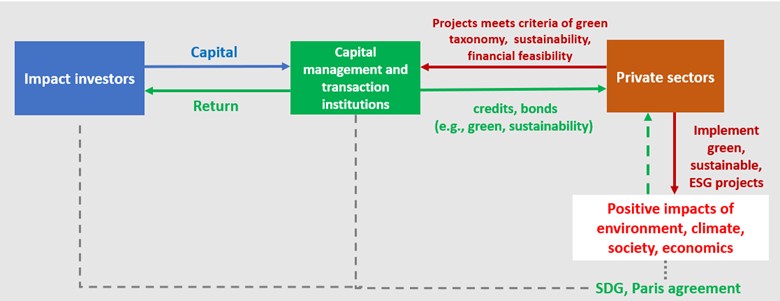
Sustainable financing is a measure to allocate capital to sustainability projects. These projects have to meet certain sustainability criteria (e.g., social, environmental, climate). Green finance is a branch of sustainable finance, although the terms are used interchangeably. Green financing allocates capital to green projects, which specifically emphasize environmental compliance and positive impact creation.
Instruments of sustainable finance include bonds (e.g., blue, green, sustainability, sustainability-linked, social transition) and loans (green, sustainability, sustainability-linked). They need taxonomies, standards, or criteria to categorize projects into specific groups of sustainability and purposes.
How is the context in Vietnam?
In 2015, the State Bank of Vietnam (SBV) pioneered green credit by issuing Directive 03/CT-NHNN and Decision 1552/QĐ-NHNN. These aimed to promote green credit and the management of environmental and social risks and the action plan of the banking sector within the framework of the Green Growth Strategy 2011 – 2020. Subsequently, the SBV also issued Decision 1604/QĐ NHNN in 2018 to develop green banks. Issuance of green bonds have been piloted in Vietnam since 2016 as a joint program between the Ministry of Finance and Germany’s International Cooperation Agency (GIZ). [1]
Green bonds issued by government and corporate have been regulated since 2018 by Decree 95 and Decree 163 (replaced by Decree 153 in 2021), respectively. Since then, regulatory management of corporate green bonds has been amended with clearer requirements for the use of proceeds, stipulated in the newest Decree 200 in 2026 (replaced Decree 153).
Green taxonomy and criteria
Circular economy, green credits, and green bonds are referred in the Law on Environmental Protection 2020 and guidance Decree 22 in 2022. This has leveraged their legal importance. With Decision 21 in 2025, Vietnam officially issued technical environmental criteria defining green investment projects, which are eligible for green credits and green bonds. In September 2026, Decision 46 defines technical criteria for green, circular economy, and ESG projects. This aims to support private economic sectors with a 2% interest rate subsidy according to Resolution 198 and Resolution 68.
Before Decision 21 and Decision 46, criteria to define sustainable and green projects have applied international criteria; guidelines and handbooks, e.g., sector ministries.
Financial feasibility of projects is still a significant indicator
Besides green taxonomy and green, circular economy, and ESG criteria, banks have their own procedure to approve projects eligible for green credits, green bonds, or interest rate subsidies. The project has to be financially feasible. It must be able to create cash flow and return on investment [2]. Additionally, except some cases, collateral or secured loan is still required [personal communication, 2026] [5].
To access this capital market, enterprises have to invest in compliance and standard reporting, which is often expensive for SMEs.
Additionally, further improvement of (sector) technical guidance, administrative procedure, and capacities across stakeholders is another challenge. [3]
Currently, green credit accounts for less than 5% of the total economy credit [4], although the annual increase is relatively high with 20% between 2017 and 2025 [2].
Clearer guidance of green taxonomy and sustainability criteria from Decision 21 and Decision 46, and the stricter use of proceedings from Decree 200, are expected to mitigate “greenwashing”. Hopefully, the private sector may have better chances to access sustainable finance, implement sustainability projects, and subsequently increase their market competition.
References
- World Bank (2021). Phát hành trái phiếu xanh, trái phiếu bền vững, trái phiếu xã hội (Vietnamese)
- VnExpress (2026). ‘Muốn vay xanh, doanh nghiệp vẫn phải đủ dòng tiền trả nợ’
- Báo Công thương (2026). “Doanh nghiệp cần làm gì để tiếp cận vốn xanh”
- Điện tử Chính phủ (2026). “Tín dụng xanh tăng tốc, mở đường chuyển đổi kinh tế bền vững”
- VCCI (2026). Gỡ rào cản tín dụng xanh
