Does a small enterprise integrate circular business models into its value chains when they see economic benefits and market competitiveness?
I visited a small furniture manufacturing enterprise in Hanoi on a rainy afternoon in mid-September. Their office was located in a fairly large new urban area. I walked from the gate. About 20 meters away, the enterprise’s director – a woman in her 40s – was standing on the sidewalk holding an umbrella to greet me.
Is the enterprise interested in circular business models?
I had previously informed her about my desire to discuss the circular business model. Like most people I contacted, she had never heard of the circular economy before.
I introduced my project. She said she was interested in the circular business model because I had mentioned the government’s incentive program and sustainable financial products the day before. Additionally, she wanted to discuss optimizing material use efficiency in their manufacturing workshop.
I presented the economic, environmental, and social benefits within her enterprise and among stakeholders in the value chain. Then I discussed aspects that could be integrated into their business model, based on the latest circular economy standards for businesses.
The enterprise consistently optimizes material use and manufacturing costs.
I asked for her feedback on the content I presented. She said she already knew most of it because she had researched the circular economy on her own after I contacted her. Optimizing material use and production costs is always a priority for their company. I asked for more details. She explained that her company uses software designed to optimize wood usage. Furthermore, she continuously optimizes the use of wood and other materials in the production process. Employees are assigned KPIs related to this. The leftover wood scraps are also used to produce small products as gifts to customers.
I asked if there were still by-products like sawdust and wood chips. She said these are reutilized by another production establishment. She added that the leftover wood scraps could be ground to produce fuel pellets, but they are unsuitable if they contain chemicals.
I admired her knowledge and insight.
The enterprise hasn’t yet focused on optimizing material flow outside their operational boundary
I then asked about used furniture. Does her enterprise care about extending the product’s lifespan? For example, processing and selling used furniture. She said that some customers also ask for help processing their used furniture when they buy new products from her company. The company also offers customer support services, but charges a fee if it’s outside the scope. This used furniture is mostly given away to others for free.
So, does her enterprise care about the source of the secondary or primary wood materials, and whether they have sustainable forest certifications? She said she’s currently only concerned about quality, price, and legality.
I continued talking about other aspects of the circular business model. The more I talked, the more I realized she seemed to know everything. However, she was interested in the procedure to achieve certifications and the responsible agencies and institutions in Vietnam.
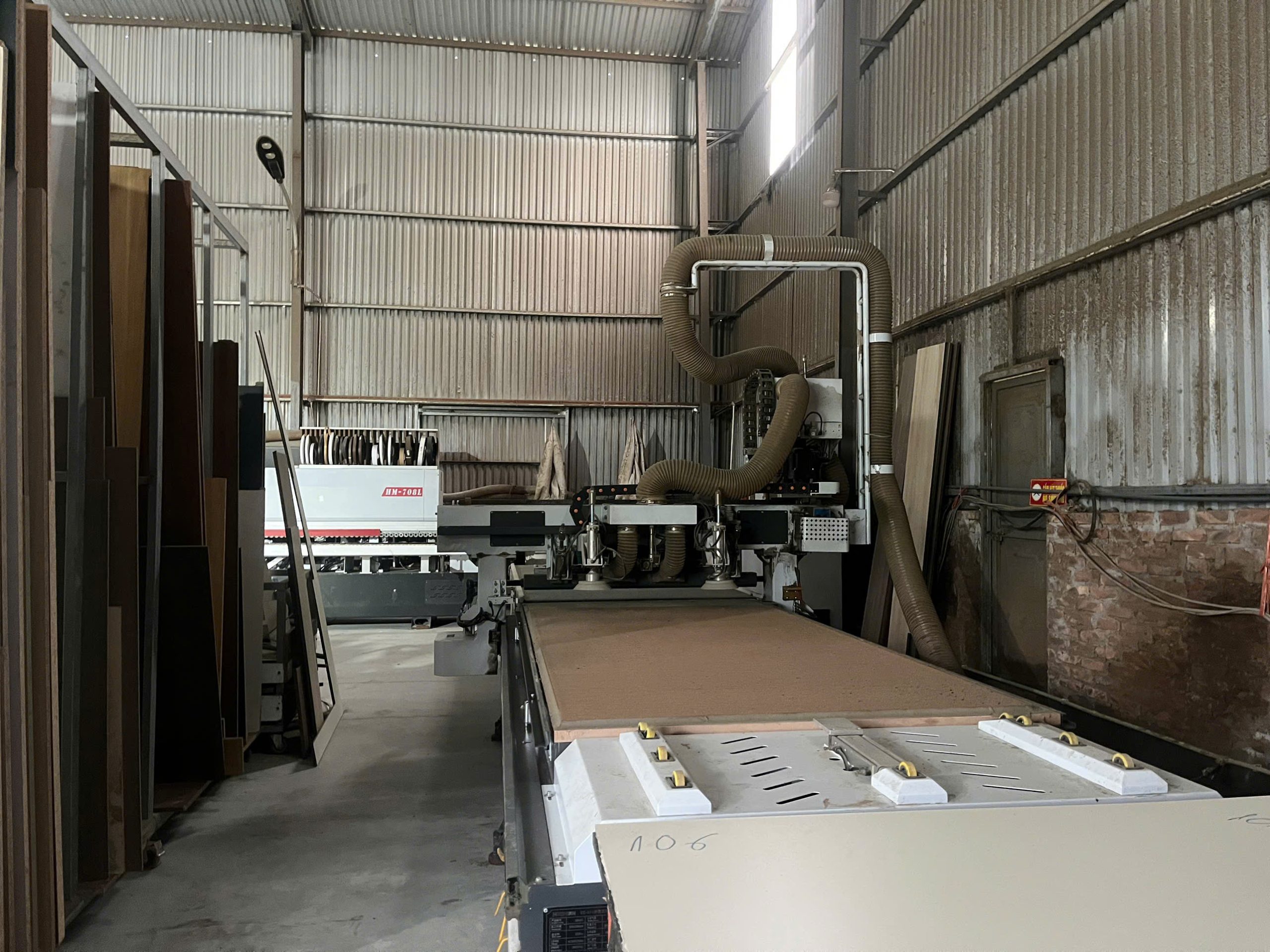
We got in the car to visit the manufacturing workshop in another area. The workshop looked very neat. I saw many machines with control panels. The wooden panels were thin and stacked in rows on racks against the wall. This was a workshop manufacturing industrial wood furniture. I observed that sawdust was being sucked into bags. The factory floor was also clean. The amount of excess wood scrap was inconsiderable and was stored in the by-product area. She explained the operation and production process to me.
Scope of assessing the performance of material circularity
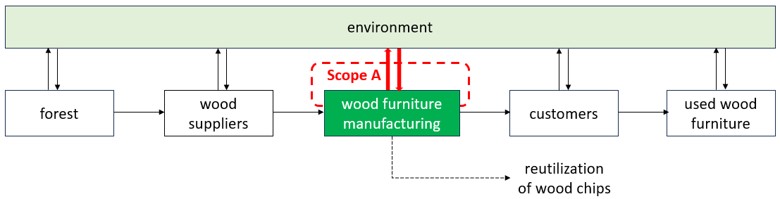
I found that her enterprise had optimized the efficiency of material use at their operational boundary. This falls under area A according to the Global Circularity Protocol for Businesses.
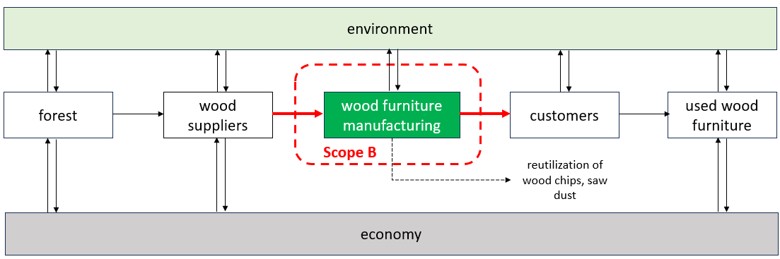
Scope B refers to the boundary where the enterprise directly purchases raw materials from suppliers and sells products to customers. The circular performance of the enterprise only assessed from scope B. Currently, her enterprise is only interested in Scope A in optimizing raw material use efficiency. She explained that this is because the law in Vietnam doesn’t yet mandate it. Most importantly, her enterprise hasn’t identified a clear market demand and economic benefits.
The enterprise could adopt a circular business model for economic benefits and market competitiveness in the future.
She said she would consider adopting a circular and sustainable business model because she understands the benefits and sees it as a future trend. However, it’s not urgent at present. She mentioned seeing the benefits from green financing packages, incentive programs, procurement requirements, market competitiveness, and targeting the export market. The next day, she told me that collecting data from stakeholders in scope B isn’t simple either 😊.
What might an export enterprise think?
I left her office while it was still raining. I was curious about the viewpoint of an export enterprise on circular business models. That’s the topic of the next article.
Nguyet Tran
P.S.:
Picture of the manufacturing workshop under the permission of the enterprise.
Illustration of scope A and scope B is modified based on training materials of Module 7. Standardized Scopes from the course “Beyond Compliance Drive change with the newest circular economy standards – Becoming a Certified Circular Analyst & Strategist supported by the GCP team and Circle Economy” provided by Current-Sustainability (2026)
