After the site visit, we decided to pilot a circular chicken farm for a family in Ninh Bình. Together with the family, I began designing the circular family by analyzing the family’s business model, starting from their customers’ profile and following the guidance of the Global Circularity Protocol for Business. Then I aligned our analysis with existing standards and guidance in Vietnam to harmonize the design of a circular chicken farm according to local text.
Two weeks after the site visit in Ninh Bình, I visited a chicken farm in Ba Vì, Hà Nội. It is the result of our decision to pilot a circular chicken farm for a family in Hải Anh commune, Ninh Bình province.
The family in Hải Anh confirms the objectives of their egg-laying chicken farm.
We begin designing a circular farm by analyzing the family’s business model and following the Global Circularity Protocol for Business. Then, we harmonize our findings with relevant standards and criteria in Vietnam. We aim to maximize material circularity performance by reducing the cost of supplying materials (inputs), improving operational practices, and increasing product revenue streams (outputs).
We analyze core products of chicken eggs based on buyers’ desires.
Fortunately, the family knows relatively well their customer segments concerning price, quality (taste, hygienic safety), and traceability of the egg. They also identify what is currently unserved in the market (proven quality and hygienic safety).
- The family reveals their concerns and desire for a chicken farm.
The family also told me what they do not like from existing chicken housing in the locality and their desired farm. Their main concern is to eliminate the stinky smell on rainy days. They desire a good climate of housing conditions to protect chickens’ health.
- We summarize the feedstocks and sensory perception of the farm.
The family told me that their customers like tasty and safe eggs from chicken that eat organic feedstock and running in garden or playing ground.
We quickly concluded the types and availability of feedstocks and the first visual and sensory perception of the chicken farm. We will design the farm and operations that increase customers’ experiences and trust in the quality and traceability of the eggs.
Possibly every one wants to buy tasty and safe eggs from healthy and happy chicken 😊
We discuss how to design the farm.
The farm, including the housing and running yard will be located in the family’s front garden. It will be covered by steel net. They will grow kudzu plants against this net. This serves two purposes: harvesting kudzu root and providing good climate conditions for the chicken.
I compare design elements with existing standards of organic livestock farming, technical guidance on egg laying chicken housing and living conditions, new circular economy criteria for livestock projects in Vietnam and reflect with the circular indicators of the Global Circularity Protocol for Businesses.
Basically, the family can technically fulfil the design from existing infrastructure and local availability.
We discuss the supply of feedstocks and other material inputs.
At the pilot scale, the family can self-supply the majority of organic feedstocks. The remaining will be provided by local suppliers. For the bedding material of rice straw, it can be freely sourced from rice fields twice per year. Local chicken species will be chosen for the pilot.
Site visit to a chicken farm in Ba Vì
To validate some of our conclusions, I visited a farm of more than 3000 chickens last sunny Saturday. The farm is located in a semi-mountainous village in Ba Vì, Northwest of Hà Nội. The area is known for its agricultural, livestock farming, and eco-tourism activities.
The owner of the farm – a woman in her mid-50 welcomed me with an energetic introduction. She has many years of experiences raising chicken and pigs and loves her work.
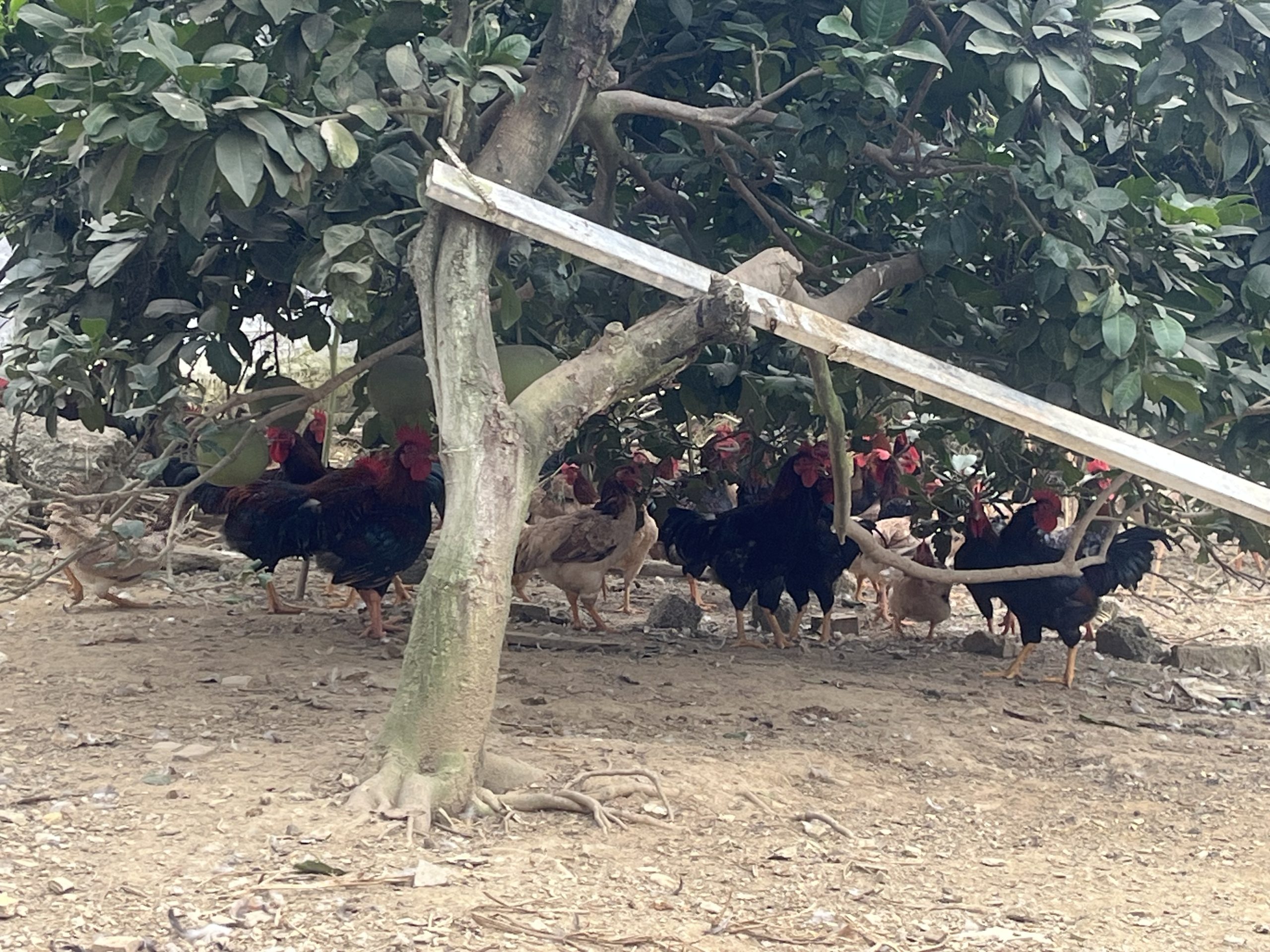
I observed several chicken coops in a very large pomelo garden. The housing is naturally well aerated and lighted. Its floor is bedded with rice husks. A long the coop’s wall there are bamboo poles as roosting bars for chicken to rest and sleep. All have large running yards and a rain-protected feeding area. The feeding is semi-automated.
Circular performance and revenue streams of the chicken farm
While I was wondering about the ecological balance of the site, the farm owner complained that the chicken price at the moment is very low. Profit is currently negative because the price of feedstock is high. The bargain power is weak because of high dependency on the limited feedstock suppliers and broiler traders and sensitive to market surplus supply.
How to diversify and sustain the supply and revenue streams of this chicken farm? Probably the farm owner already did her research. Obviously, it is not easy. I think of possible and similar challenges once upscaling the circular and sustainable chicken farm for the family in Ninh Bình.
The woman told me suddenly that she also sells the bedded rice husks from the coop. It is high demand, she referred. Kind of organic fertilizer and circular revenue, I thought!
I left the farm. The woman gave me a dressed chicken, a local specialty – Gà Mía Sơn Tây, as a gift from her farm.
Chicken eggs’ quality and traceability
On the way to the bus stop, I visited a household in this village. The landscape of the house is extraordinarily impressive. It is a combination of Hội An’s ancient farmer architect, modern life style, and nature-based solutions. The sunny autumn atmosphere made the scenery even more artistic, romantic but still cozy. I ate two boiled chicken eggs harvested from their small farm. Their chickens are fed by organic feedstock to ensure taste and quality of eggs. These products are served mainly to meet their families’ demands.
I left the village before noon with thoughts of the chicken farm, the energetic farm owner, and the lives of people in that Hội An style house.
