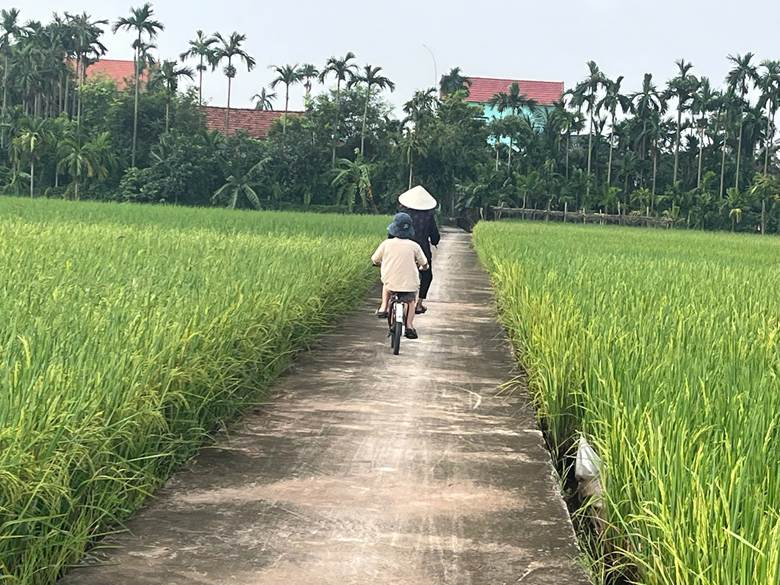
I want to do something to improve our lives here. Agricultural practices bring little economic value, making life less comfortable. A spontaneous discussion with a friend led a mutual friend and me to visit her hometown in the old province of Nam Định last weekend. Let’s discuss the possibilities of circular agriculture businesses in your village!
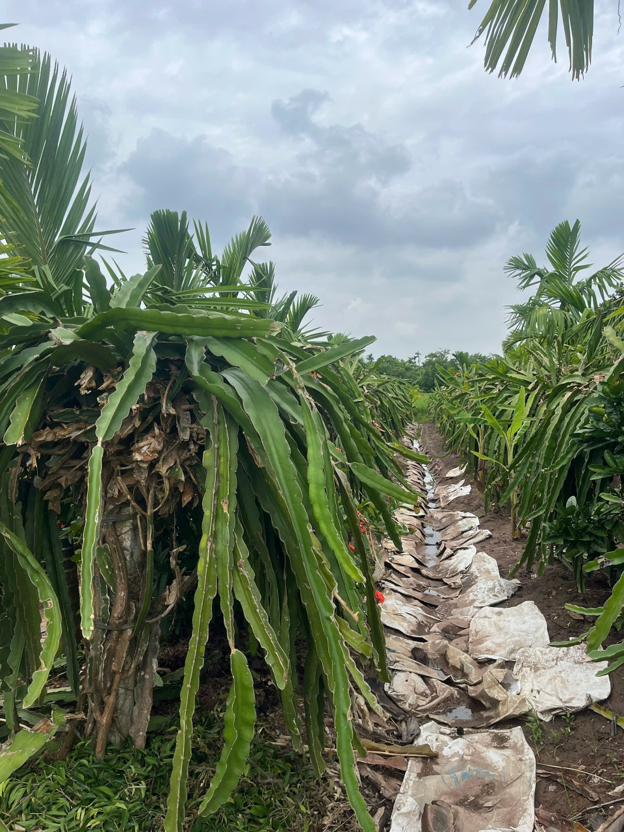
In front of the house are a green rice field and neighbor gardens, making the landscape more picturesque with rows of betel palms. We immediately visited the field and the family’s dragon fruit garden. Finally, we sat near a canal under the canopy of a tall tree. It was very comfortable, with the clean air and the sweet smell of the rice flowers. We talked about life between rural and urban settings, the environment, human behavior, and agricultural business opportunities here. It sounds like: more opportunities to earn money but also more pollution in the urban areas versus less money and a cleaner environment in the rural areas (at least here).
Does life have to be like this? Surely it is only a temporary state because there are still green, clean, and rich (developed) countries.
We continued the discussion in the afternoon.
How can I secure the input for the composting? How can I secure and increase the economic value of products from my circular chicken farm and circular dragon fruit? My friend suddenly asked.
The idea of composting is a means to regenerate biomaterials (e.g. from dragon fruit and/or chicken farm) and provide natural organic fertilizer. However, upgrading it to a larger scale requires a stable supply of inputs, which could be sourced from market biowaste and rice straw (currently burned after harvesting).
Similar to other interviewers, my friend expressed why does she has to invest in this circular business models if her products are sold with same price of conventional ones? This question can be technically solved; you follow standardized or recognized procedures for your production. This can be applied step by step from the beginning of the business design, from upstream to downstream material flows in your value chain depending on your investment capability. We can co-create this process. To leverage the economic value of your products, your production process has to be assured by independent third parties. You get certified for your production and your products. All this help you to satisfy conditions of premium markets or attract customers who are willing to pay higher prices for your products. That is the advantage of market competition for sustainable and circular production. This does not mention other environmental benefits and cost savings from circulation of resource use (resource efficiency). I explained briefly, but also understand that there are lots of jobs behind the scene to figure out a viable business model.
In the evening, we visited her biological parents, who live near her house. It was a wonderfully cozy atmosphere with a slight wind, clean air, and moonlight. We sat outside in the front yard, helping her mother separate newly harvested corn grains. Her father joined the talk until 21:00, then he left for the night shift as a security guard at a school. Her mother later switched to do another task of folding paper gold ingots – a joss paper often used for worship ceremonies. Both of them are doing different small jobs besides agricultural activities for their living. We stayed there until late that night.
We visited another rice field and left the villages for Hanoi the next day with fulfillment and a promise to revisit.
This morning, I asked my friend to check information from the newly released criteria defining ESG, green, and circular economy projects in Vietnam (Decision 46, published on 17th September 2026). The decision aims to promote these businesses with a 2% loan interest advantage. Her business projects of composting, circular dragon fruit farm, and circular chicken farm are all included in the categories. We will first revise this information and compare it with the Global Circularity Protocol for Business to find out the next steps.
