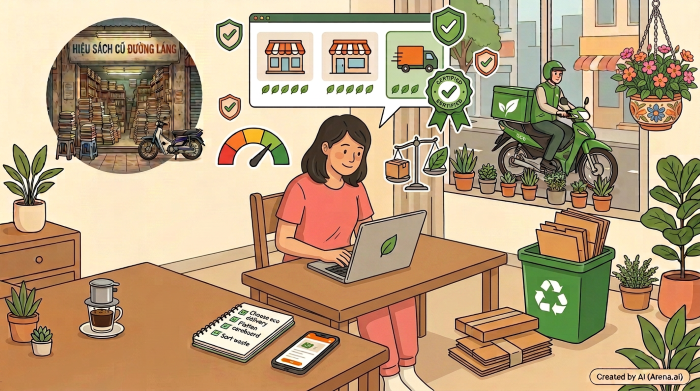
Returning to my questions about online shopping in Vietnam (part 1), after revisiting my experiences, I believe that many people and organizations have also noticed this situation. The difference lies in the degree of seriousness. And I again wonder, how to recognize this? Their actions, most probably! These range from very simple, possibly short-term, and superficial activities to long-term ones. And what drives their actions? By chance, I discussed a close topic with a colleague of mine last Friday. My colleague mentioned “financial benefits” of business cases that drive their actions. Yes, BENEFITS, highly possible! However, I suppose, these can be multidimensional “benefits”, not always directly linked to financial perspectives.
I have witnessed a number of organizations, both from governmental and private sectors, have taken initiatives, although at different scales, to reduce the usage of plastic materials or increase the rates of recyclable packaging. However, I found little information about their solutions to online packaging (plastic) waste. Do people in general and organizations NOT worry much about the waste and emissions generated from digital shopping? I did google a bit and found an article mentioning that a local post service has applied solar energy to their warehouses and tried to optimize shipping routes to reduce energy consumption and transportation emissions. Not too bad! This makes me curious to continue searching for what might come next. Not surprisingly, the Government of Vietnam is preparing a draft law on e-commerce, expected to be issued around the middle of next year. Accordingly, it will legally require e-commerce businesses to disclose their “green compliance”. (This is somewhat part of the answer to my second question.) This situation shows that the majority have noticed the situation of online shopping waste and emissions. Some actions against these have started, although at various degrees of seriousness. I therefore think that the answer to my first question is not addressed, but it is in a state of being considerably concerned, researched, partially piloted, and applied. I let the answer open 😊. By the way, my first question is “How to properly regulate the waste and emissions generated from these activities? The bookstore, the digital commerce platform, the shipping service? How to distribute the responsibilities?”.
The second question is ”How can I, as a general customer, select the bookstore or the platform, or shipping services that are officially certified so that I can opt to support the digital and green economy in a more comfortable manner?”. If there are two options between the so-called sustainable products and services versus the remaining, a question would arise before deciding: what is better for me? Two important aspects concern me the most: (1) price difference and affordability, and (2) reliability and meaningfulness of the certification of the “more sustainable” choice. Oh my god, with the second aspect, I need to trust in my knowledge of sustainability and the certification, at least. In case of buying books last time, I saw no options or no clue of “more sustainable” choices. Clearly, I chose the cheaper ones. My mind again wonders: will it be more complicated, if I buy other products, for example, foods, that offer various certification schemes of sustainability and different levels of price? These are probably luxury problems of choice in the far future?
The third question is “How can we apply circular ecology tools in this case to boost the healthy competition and sustainable business models?”. I do not intend to provide answers here, as I believe there are technically more solutions to this. It is only a question of how to implement it feasibly in the context of Vietnam. I support the statement of my colleague and friend about the relationship between noticing, measuring, believing, and acting. In this case, I would relate her “measuring” to the ”material flow analysis”, as one of the technical tools for circular ecology/economy. My practical experiences in analyzing material flows of agricultural food processing in craft villages in Vietnam confirm this. The material flow analysis can help identify the hotspots to be improved or what should be optimized. On this basis, further solutions can be applied to fulfill the goals of effective resource and environmental management or legal compliance. An important aspect is the question of financial sources for reliable data acquisition and later implementation of circular solutions. This deserves other discussions, hopefully soon.
P.S.: For me, it is somewhat admirable that in many public squares of villages, towns, or cities in Germany, there are free street bookshelves. Most books were of good quality, although they were used. Is this a good example of circularity of materials, and foremost, knowledge, culture, and kindness😊? Yet, I wonder about the future of these bookshelves in the digitalization era and ask myself about the case of Vietnam.
Nguyet Tran
This article was first posted on LinkedIn on 14/11/2025.
Image is created by AI with commands from Nguyet Tran on 08/08/2026.
