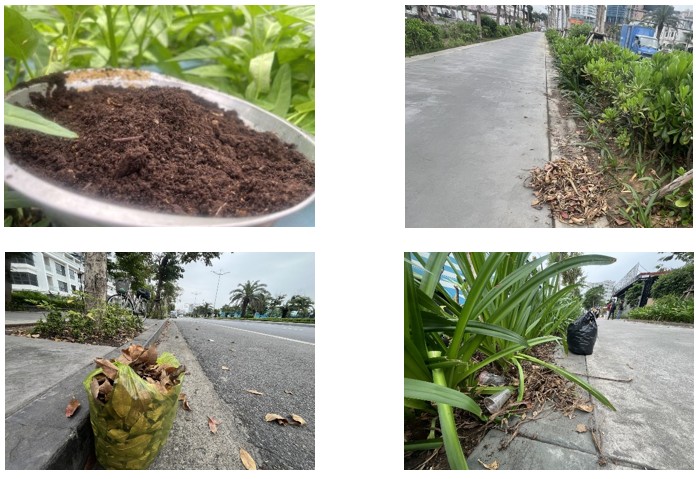
“You know what, the compost is very successful, it looked like fine and humorous soil”. My mom said with an excited voice during a sudden call from last summer. I immediately asked her about its smell. “Like fertile, humorous soil”, she said. I was happy as well. Although my mom has no experience with composting of biowaste – here the kitchen leftovers, I believe in her “assessment”: my mom was previously a farmer and familiar with fertilizers.
Around the mid-1980s, I remember there was often a big pile of something behind our house. Still a small child, I understood that it was some kind of fertilizer, because I often saw my mom take the materials out of the pile and put them in the rice field. I called her for further clarification. “I used pig manure. The pile was sealed with pond mud. It is ready to use after several months when the smell is gone”, she explained.
I wanted to know if she used inorganic fertilizers back then. “Very little, only when the rice needed it most.” Why? “We didn’t have much money. But some families were better off and used more,” she said. I recently learned that Vietnam began using inorganic fertilizers around 1960, and their use increased rapidly from the early 1990s. Inorganic fertilizers were quite expensive for most farmers around the mid-1980s. However, today they may even be overused!
Back to the kitchen waste composting.
After several years of living in Germany, I became accustomed to waste sorting. Additionally, working in the field of environment focusing on material flow analysis, I have been more or less “obsessed” with the optimization of biodegradable waste flows, which are otherwise disposed of along with the mixed waste stream. When coming back home in Vietnam, I also many times felt uncomfortable if not separating waste, at least for the biodegradables and recyclables. I decided to make a trial composter with a Styrofoam box of about 0.25 cubic meters (m3) for our kitchen leftover after referring to guidelines and practices. The design and material were not that professional, but it offered a quick, easy, and feasible solution. Months later, my mom took over this “project”, with some reluctance 😊. I tried to explain to her a rule of thumb: ratios between the “greens” (like kitchen waste – fresh vegetable and fruits leftover, nitrogen-rich), the “browns” (like dry leaves, carbon-rich), water (if needed), and atmosphere (oxygen source). Now my mom does the composting with more comfort: she trusts the process and witnesses its effectiveness for her balcony plants. It is, however, still a learning process for both of us.
“What are you doing? Why?” It is a frequent question from tourists and people passing by the sidewalk, where I sometimes collect dry leaves for my mom’s composting, when visiting my hometown. “To compost”, I reply. It is still uncommon for many, I suppose.
The Law of Environmental Protection 2020 stipulates that from January 2025, municipal waste has to be sorted, including organic waste (biodegradables). Waste sorting is, however, still fragmented in Vietnam due to the lack of a synchronized waste management system. I am still not sure if households have to pay extra if they don’t separate organic waste from the mixed waste stream. In Vietnam, organic waste accounts for at least half of the household waste. If only mixed waste is charged for collection and processing, could this be an incentive for more families to sort their waste?
The story of my mom’s composting is simply a personal interest. To be more applicable, home composting should be simpler and easier, technically, financially, and conveniently. If effective waste sorting and home composting, along with a healthy connection with nature and society, are necessary, could planting trees and/or gardening (at home or in communal locations) be a new sustainable trend in Vietnam, especially in urban settings? In this regard, I hope to come up with another article.
Note:
– Scope of the article: This article does not address compost quality related to the composter material (e.g., microplastics from Styrofoam box) and potential impurities from dry leaves collected from sidewalks.
– Note: We do not use any E.M (Effective Microorganisms) products in the composting.
Nguyet Tran
P.S.: This article was first posted on LinkedIn on 01/02/2026.
