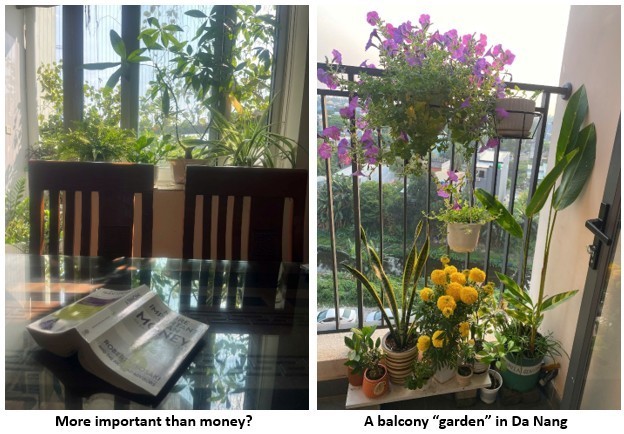
“I think I am experiencing a midlife crisis. I find no connections to what I am doing”, a friend has just shared. She continued, “As a consequence, I could not sleep last night until early morning. Today I called in sick”. She sent me a photo showing a view from her seat in front of a dining table next to a window and a balcony of her apartment. I saw a book “More important than money: … an entrepreneur’s team” (Robert Kiyosaki et al.) lying on that table. The scenery looks fantastic with many plants. Sunlight streams across the window into the apartment. I can imagine my friend is relaxing with great joy in this nature-friendly apartment. She suddenly asked, “Do you think this is true?” She added, “If these plants and nature-like scenery are more important than money?” Oh, I don’t know the right answer. She explained: “More importance than money in the fact that today I feel a bit sick due to the stress of mid-life crisis (!) … Paralyzing. These plants and nature-like apartment calm me down. Otherwise, I would be more depressed, or I would have to go somewhere else to release stress. I will do some gardening now”. I replied, then: “Yes, more important than money, but only for your today’s afternoon!” 😊.
Living in Hanoi with frequent exposure to air pollution and lack of green space, my friend “grows” her apartment with lots of plants. She could be among exceptional cases, as she is a nature and plant lover. Not really. I remember a television program a few months ago, showing a roof-top garden of a woman in Nam Tu Liem, Hanoi. From a bird’s-eye view, the garden looks like a magical green and colorful point with a variety of vegetables and flowers, against other dense houses with “blank” roofs. The woman has grown this garden of 30 m2 since 2018, starting with a small amount of money and self-made frame and organic fertilizers. She, an accountant, mentioned that daily gardening helps her release stress from work. Maintaining this garden is hard work, but it also offers her lots of unmeasurable joy! Her garden not only provides foods for her family but also an entertaining gathering with friends and acquaintances.
Healthier soul, healthier psychology with nature and green space? Johann Hari, author of the well-known book “Lost Connections”, scientifically identified the disconnection from the natural world is one of the key factors (among nine causes) triggering depression in human (besides chemical imbalance). This is not new. The Japanese already developed “forest bathing” as psychological ecotherapy in the 1980s, emphasizing the importance of forests to human health. My friend, after finishing her gardening on the balcony, totally agreed with this exchange.
There is another reason for the majority of urban rooftop/balcony gardeners: the lack of safety from vegetables/fruits (foods), especially families with old people and/or small children, who are more vulnerable to unsafe foods.

The rooftop gardening phenomenon is not only in big cities like Hanoi, but seems to be a trend in Asia, also mainly responding to demand for safer foods and a means of slow living and stress release. Curiously enough, just about to end this article, I have just further found a paper published in 2024 concerning urban gardening in Hanoi and the Global South. The authors emphasize the need for residents in Hanoi to “access safe, fresh, and affordable produce through rooftop gardening”. They then come up with the recommendation of possible pro-rooftop garden policies. Apparently, this concern is not at all new in Asia. It was even scientifically researched decades ago. By the way, this reminded me of the time living in Germany. I always feel very lucky whenever thinking about my rented community house. It is located close to a wonderfully beautiful Schreber Garden (Schrebergarten) area and many nice small gardens of other houses in the surrounding. They were really precious moments of memory whenever walking around this area. Schrebergarten originated in the 19th century in Germany as a result of industrialization und urbanization, responding to the demand on outdoor activities (e.g. playground for school children) and food security. It is a small plot of land often located in the vicinity, where city dwellers can practice gardening; nowadays, more often as a hobby. The operation of these small gardens is not spontaneous, but ruled by a specifically designed law (Bundeskleingartengesetz), surprisingly, already issued in 1983. I don’t know if we will have such kind of laws or legal regulations for urban gardening in Vietnam.
My mind wanders back to the talk with my friend and ask her: What is the book “More important than money: … an entrepreneur’s team” about? Basically, it guides you on how to earn money, in achieving other “things” which are more important than money, like private financial freedom and personal growth. She answers. My friend further implies that something more important than money is maintaining some essential connections to, such as nature, society, meaningful work, and physical health, as referred to by Johann Hari in “Lost Connections”. I am reconnecting this to the above reasons for urban gardening in Hanoi.
I am doubting if we can balance these connections without a (potential) certain financial foundation …
Is it feasible if we can still make money, and simultaneously enjoy other things, and create such meaningful connections not only to yourself but also to others?
I am thinking that …
Vietnam is promoting the circular economy as one of the sustainable economic models, in which high-tech and circular agriculture is one of the key sectors. Waste sorting is soon compulsory, and composting of domestic biowaste is possibly feasible. Under the current urban gardening and/or demand for green spaces within reach (e.g., private houses, apartments), could circular economy service providers offer attractive business opportunities? Is it feasible to earn money with meaningful jobs to provide something more important than money for customers?
P.S.: Thousand thanks to An Phương for valuable comments and pictures!
This article was first posted on Linkedin on 2 May 2026.
