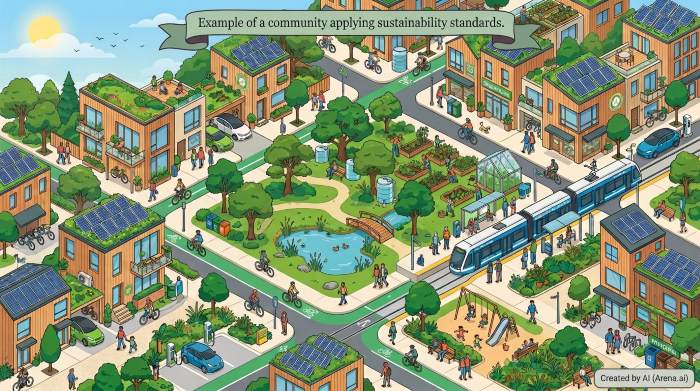
Sustainability and ESG assessment
Sustainability is an overarching concept. In the context of this article, it relates to sustainable development defined by the UN Brundtland Commission in 1987
Corporate sustainability is the balance of the requirement of enviromental, social and economic pillars, aiming for long-term sustainable development. ESG consists of environmental, social, and governance criteria. These criteria often overlap with the three pillars of sustainability. However, they are different. Sustainability focuses on the inside-out impacts of a company on the world (impact materiality). ESG focuses on the outside-in impacts of the world on the company (financial materiality). The main audiences for ESG are investors, business partners/stakeholders in the supply chain, and regulators. The major aim of ESG is compliance. Its nature is data-driven. Audiences of sustainability are broader, e.g., employees, customers, shareholders, public and local communities. The main aim is usually narrative. Its nature is mission-driven. This difference shows that ESG has more specific/clearer criteria and standards than sustainability. [1]
Certain investors or business partners require ESG disclosure to support their investment or procurement decisions. ESG can function as a subset of sustainability. Modern sustainability and ESG reporting like CSRD require disclosure of both impact and financial materiality (double materiality).
Practical settings
In practice, sustainability and ESG is often used interchangeably. Following are examples of global frameworks, guidelines, standards that can be used for both sustainability and ESG reporting, independently or complimentarily (synthesized from [1], [2], [3]): Global Reporting Initiative (GRI), Sustainability Accounting Standards Board (SASB*), European Sustainability Reporting Standards (ESRS), Task Force on Climate-Related Financial Disclosures (TCFD*), Climate Disclosure Standards Board (CDSB*), International Organization for Standardization (ISO), The Carbon Disclosure Project (CDP), Greenhouse Gas Protocol, The United Nations Global Compact, EU Taxonomy, etc. (*now belongs to International Sustainability Standards Board – ISSB).
Investors, financial institutions, and industries may require different sustainability and ESG compliance depending on the nature of investment and industrial sectors. Countries also have different regulations and initiatives of sustainability and ESG for corporates and enterprises [3]. Similarly, application can be voluntary or obligatory depending on the jurisdictions, size of corporate, and aims of investors, financial investment requirements, and enforcement timeline, etc.
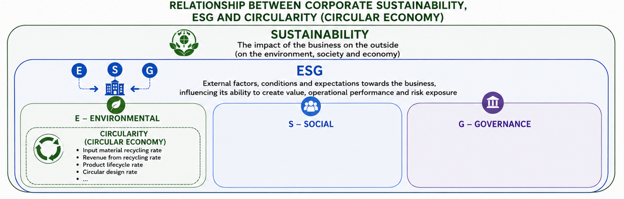
Image created by ChatGPT
Role of circular economy within sustainability and ESG frameworks, standards and guidelines
Currently, the EU leads the standardization of circularity for the global economy under the Circular Economy Action Plan and European Clean Industrial Deal. Circularity is considered a core pillar of industrial competitiveness in the European Clean Industrial Deal [2]. Circular economy is often located within the elements of “Environment” of sustainability and ESG. Transitioning to circular economy business models is increasingly integrated not only in sustainability and ESG reports but also used as separately complimentary requirements, depending on specific requirments of investors, regulators, and industrial sectors.
Examples of sustainability and ESG standards and guidelines referring to circular economy are European Sustainability Reporating Standard (ESRS – E5), EU Taxonomy, and GRI )303, 306). The ESRS – E5 and EU Taxonomy require circularity as mandatory disclosure for in-scope corporates.
The Global Circularity Protocol and ISO 59000 series provide harmonization of circularity. “The ISO 59000 series provides the management systems architecture (the “How”) based on global public consensus. The Global Circularity Protocol (GCP) provides the unified performance logic (the “Signal”) based on industry best practices, ensuring that data is comparable and investment-ready across all borders.” [2]
There are additionally a number of complimentary circular economy standards, guidelines and certifications, for example: CTI, C2C, B-Corp, TNFD (LEAP), IRIS+, IFRS (S1, S2), and ISO 14051. [2]
Depending on the context, circular economy standards, guidelines, and certifications can be used to fulfil “environmental” and circular economy elements of sustainability and ESG or exclusive requirements.
Next article (part 2): Corporate sustainability, ESG and circular economy assessment and standards: context of Vietnam
Nguyet Tran
Note: Image created by Arena.ai and ChatGPT with commands from Nguyet Tran.
References
- Green Business Benchmach (2024). ESG vs. Sustainability Reporting: Key Differences Explained
- Current-Sustainability (2026): Module 3. The core standards within the training “Beyond Compliance Drive change with the newest circular economy standards – Becoming a Certified Circular Analyst & Strategist supported by the GCP team and Circle Economy”
- State Securities Commission of Vietnam and International Finance Corporation (2013): Sustainability Reporting Handbook for Vietnamese Companies
