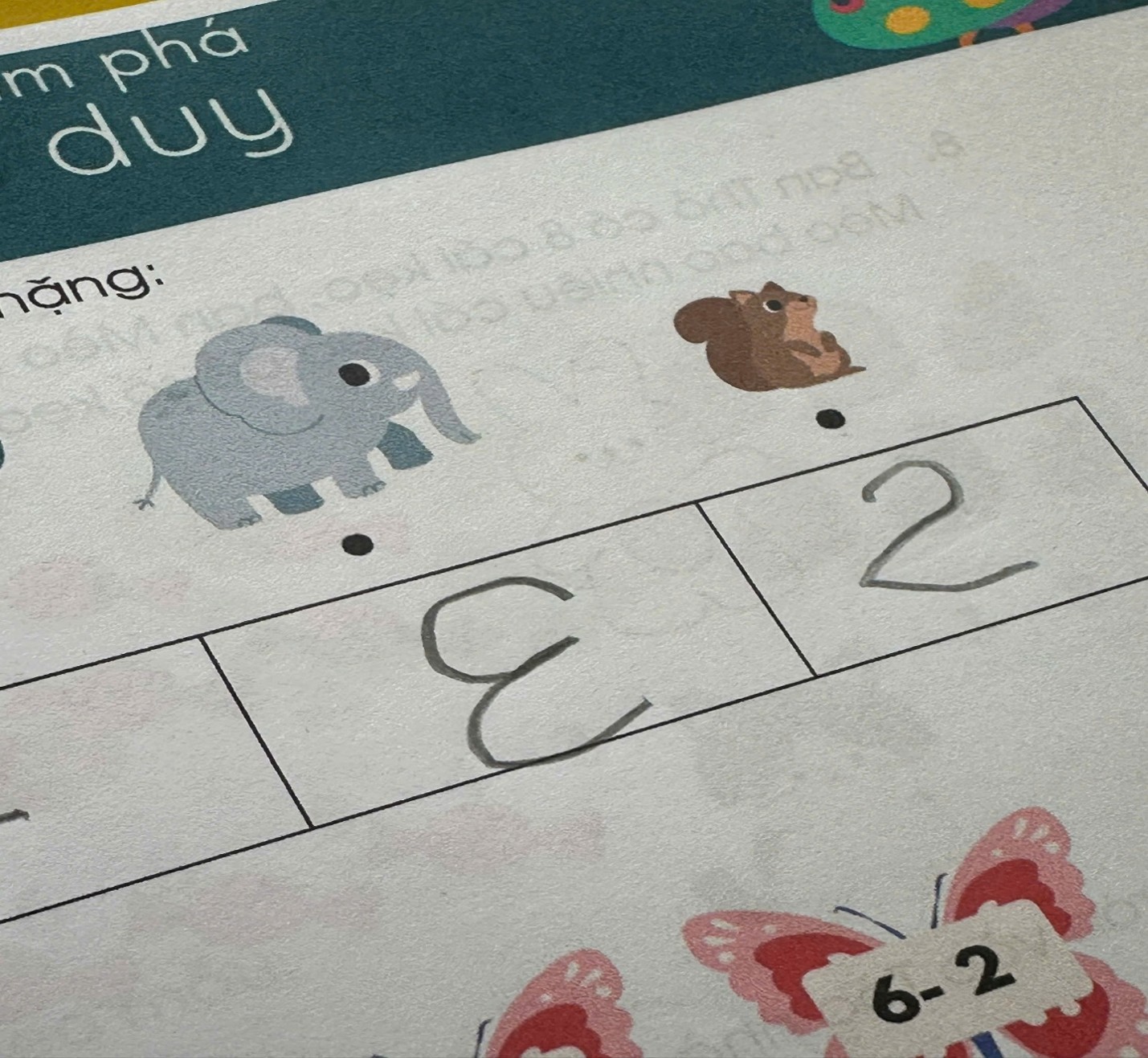
“Teacher, why does my child write numbers upside down?”
“Teacher, is it okay if my child writes numbers upside down?”
“My child knows addition and subtraction, but writes numbers like a mirror.”
“My child always writes numbers upside down. My husband and I teach them all evening, but they still make mistakes. We just shake our heads.”
These are common concerns I receive from parents, especially when children are just starting to learn to write letters and numbers. Many parents are worried when they see their children writing numbers upside down. They wonder if their child has learning difficulties and if this will become a hard-to-break habit.
In reality, when I tutor young children, I encounter many cases of children writing numbers upside down like this. Even when I write the number 3 above, they copy it down and it becomes an upside-down 3. This isn’t uncommon; it happens to most children under 6 that I’ve worked with.
So, is a child writing numbers upside down really something to worry about? Let’s analyze it together!
In most cases, children writing numbers upside down is a normal developmental phenomenon in the early stages of learning to write. To understand why this happens, we need to understand how a child’s brain learns to memorize symbols and develop spatial orientation.
For adults, numbers are very familiar symbols that the brain can recognize immediately. But for young children, each number is a completely new symbol that they are introduced to and need to memorize. In the early stages, children often remember the shape of the number but find it difficult to remember its exact direction. Therefore, they may remember and write the strokes but in the wrong direction.
To write a number correctly, children need to understand and identify left and right, up and down, and the direction of movement to guide the pen. If a child’s spatial orientation is limited, they may write in the wrong direction without realizing the difference. In addition, when writing, children must observe the model, remember the shape, and control their fingers. This requires skillful hand-eye coordination; otherwise, children may easily write in the wrong direction even if they know which number they are writing.
Neuroscientists believe that the human brain is designed to recognize an object regardless of how it is viewed. For example, a cup is still recognized as a cup whether it is turned left or right, and a ball is still a ball regardless of the viewing angle. However, this is not entirely true for letters and numbers; changing direction can alter their meaning. For instance, the number 6 becomes 9 when reversed, and the letter b becomes d when reversed. In the famous science book “Reading in the Brain” by Stanislas Dehaene, a French cognitive neuroscientist, it is explained that when children learn to read and write, the brain has to “retrain” part of its system to distinguish symbols that differ only in direction. This requires time and practice.
In a clinical report published in 2011, the American Academy of Pediatrics stated that children in preschool and early elementary school may write letters or numbers backwards as they learn to memorize the shape and direction of symbols.
I can give a relevant example about my niece. When she was younger, she was curious and liked to scribble with a pen from a very early age; she also wrote letters and numbers backwards. However, instead of forcing her to write correctly immediately or scolding her when she made mistakes, her parents gently guided her and patiently waited for her brain to mature. Later, when she reached school age, her reverse writing stopped, and her studies proceeded completely normally. Currently, she is a student at Hanoi-Amsterdam High School specializing in mathematics. She loves learning and consistently achieves excellent performance.
In short, writing numbers backward in children under 7 years old is a normal developmental phenomenon. The act of writing numbers backward alone is not sufficient to conclude that a child has any learning disability or vision problem, as many parents worry.
Hà Giang
P.S.: This English version is translated by Google Translate from the Vietnamese version with revisions.
