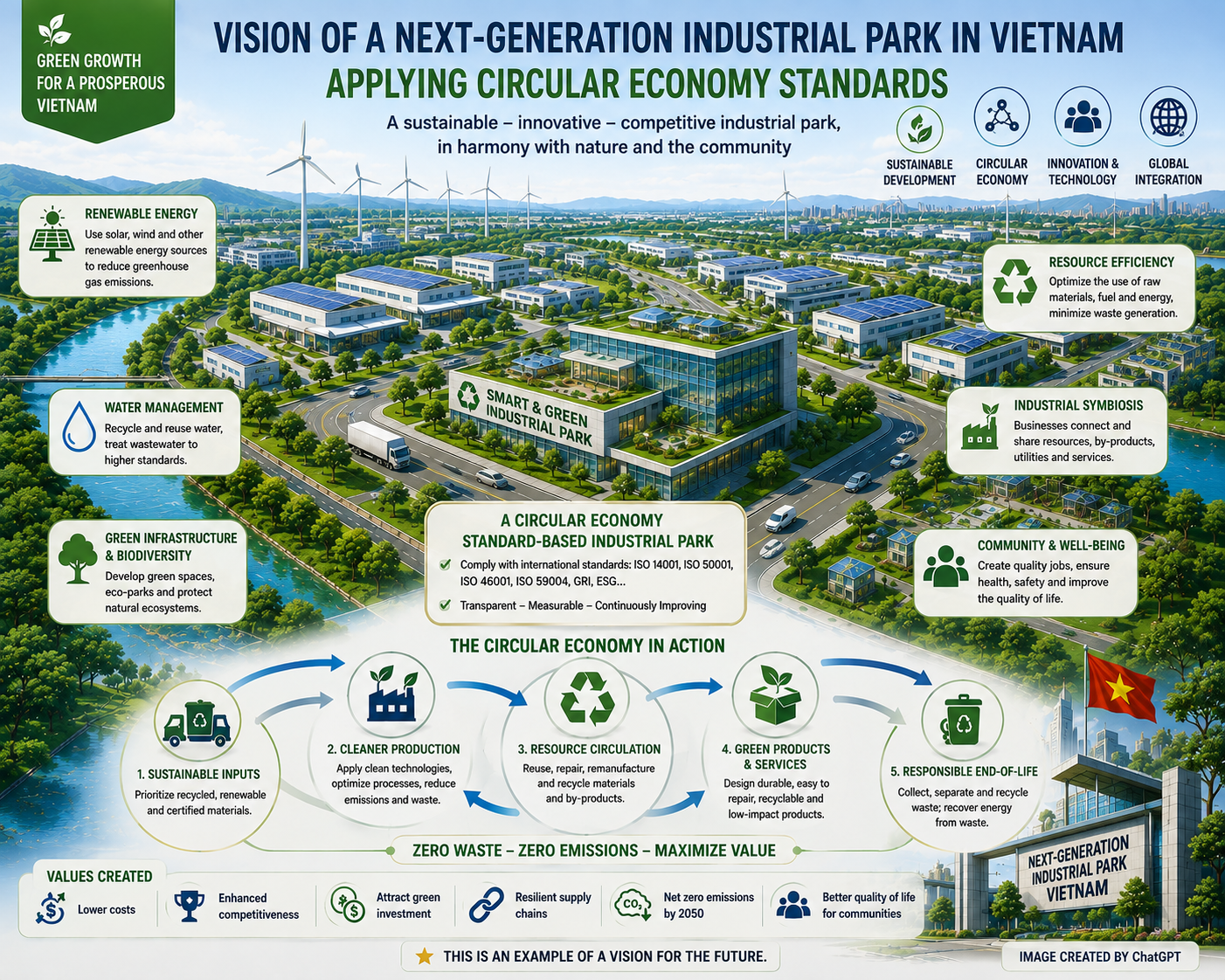
The Vietnam Industrial Summit 2026 on 10th July in Hai Phong stated that Vietnam wants to develop new-generation industrial parks to attract high-quality investors.
What is new-generation industrial park?
This concept implies the differentiation from conventional industrial parks, which are often geographically and socially standalone zones. The new-generation parks are not purely manufacturing facilities but are designed as integrated ecosystems that combine “logistics, digital infrastructure, innovation, housing and essential services with a green and sustainable living environment”.
A specific priority is to develop or transition to eco-industrial parks, where requirements of circular economy models and international environmental standards, among others, are met.
In Vietnam, eco-industrial parks can be officially certified by the government if they comply with strict criteria and guidance in Decree 35 (2022) and Circular 05 (2025), respectively. So far, there are no officially certified eco-industrial parks in Vietnam.
Vietnam is among developing and emerging countries selected to pilot the transition of conventional industrial parks into eco-industrial parks within the Global Eco-Industrial Parks Program (GEIPP), implemented by UNIDO and financially supported by SECO. The transition follows criteria of the International Framework for Eco-Industrial Park, developed by the World Bank, UNIDO, and GIZ. Currently, Vietnam is in the 2nd phase of the GEIPP (2024 – 2028) “Scaling up Eco-Industrial Park Approaches to Promote Circular Economy”.
It can be seen that the application of circular economy approaches is the major objective of eco-industrial parks or new-generation industrial parks. The circular economy is apparently gaining significance. In this case, the question is how to measure their circularity performance and impacts.
A standalone circular economy standard does not yet exist in Vietnam, but green taxonomy (Decision 21 in 2025). Which circular economy standards can be applied, certified, and internationally and nationally recognized in the context of Vietnam?
P.S.: Thank you An Phương and Hà Giang for the comment.
This article was first posted on Linkedin on 18 July 2026.
Image created by ChatGPT with commands from author Nguyet Tran, 07/08/2026.
