In today’s technological age, smartphones, tablets, and platforms like TikTok, YouTube Shorts, and Facebook Reels have become a familiar part of children’s daily lives. Early exposure to technology can be beneficial if used correctly under adult guidance. However, when children spend too much time watching short videos without a clear purpose, their brains can develop a condition called “Popcorn Brain.”
“Popcorn Brain” was first coined by Dr. David Levy (University of Washington, USA) in 2011. This term describes a condition where the brain is overwhelmed by rapid, intense stimuli, leading to a significant decline in concentration, memory, and behavioral control in daily life.
So why is this syndrome called that? Because its mechanism is exactly like how popcorn pops. Corn kernels remain dormant and only crackle and pop when exposed to extremely high temperatures.
Short videos on current platforms are designed to be incredibly engaging, with dramatic and suspenseful storylines starting from the first 3 seconds, followed by continuous motion for a few seconds. This is combined with fast-paced sounds and eye-catching effects. Children watching these videos will scroll continuously, regardless of whether it’s a funny video, a shocking video, an interesting video, etc., as their brains begin to anticipate such quick rewards. This is when the child’s brain is flooded with dopamine (the hormone of excitement and instant reward).
What will happen if things continue like this? Reading a few pages of a book becomes too slow, a 30- to 45-minute lesson is too long. Even playing with building blocks, drawing pictures, etc., becomes very boring. In reality, many children today find it difficult to sit still and study seriously for 30 minutes, but can spend hours watching short videos.
Frequent exposure to such fast-paced content leads to decreased concentration, impaired short-term memory, and difficulty in absorbing knowledge. Many children lose focus and attention in class, forget what they’ve learned, become lazy readers, and lack perseverance when faced with challenging problems requiring critical thinking.
When deprived of computers and phones, many children exhibit irritability, constant shouting, restlessness, and a loss of interest in other activities. If this continues, it will limit their creativity, communication skills, and ability to adapt to activities requiring high concentration.
This doesn’t mean technology is the “culprit,” but rather the way it’s used. The important thing is to help children learn to master technology instead of letting it control them. When properly guided, technology can be an effective tool for learning and knowledge exploration. Parents need to establish appropriate rules for device use, for example, limiting screen time to about 15 minutes a day, adjusting the limit according to the child’s age. Especially, avoid short videos before bedtime and during meals.
Children learn more from what they see daily than just what they are taught. Children are mirrors reflecting their parents’ behavior. If parents frequently use their phones during meals and constantly watch short videos in their free time, children will naturally consider it normal and gradually develop similar habits.
To reduce screen time, parents should proactively put away their phones and spend time talking, reading, creating games, and participating in outdoor activities. From there, children will gradually learn to enjoy and explore many interesting things in life without the constant stimulation of short videos.
The family is always the first and most influential educational environment. Therefore, to help children overcome the “screen burn” phenomenon, the first thing to change is not only the amount of time children spend on their phones but also the parents’ own screen time habits. Let’s build healthy habits with our children every day, starting today.
Author: Hà Giang
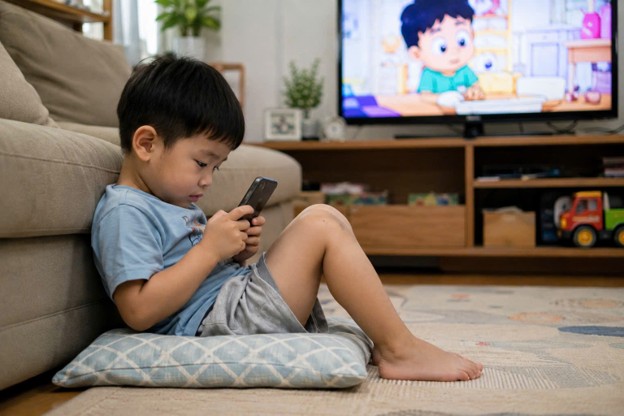
Caption for photo: Watching many short videos can affect a child’s ability to concentrate. (Image created by Chat GPT with command* written by Ha Giang, August 6, 2026)
ChatGPT command*: Please create a picture for me of children playing with phones or watching TV at home. The picture would be suitable as an illustration for a web article.
Translated by Google Translate from Vietnamese version, with slight modification.